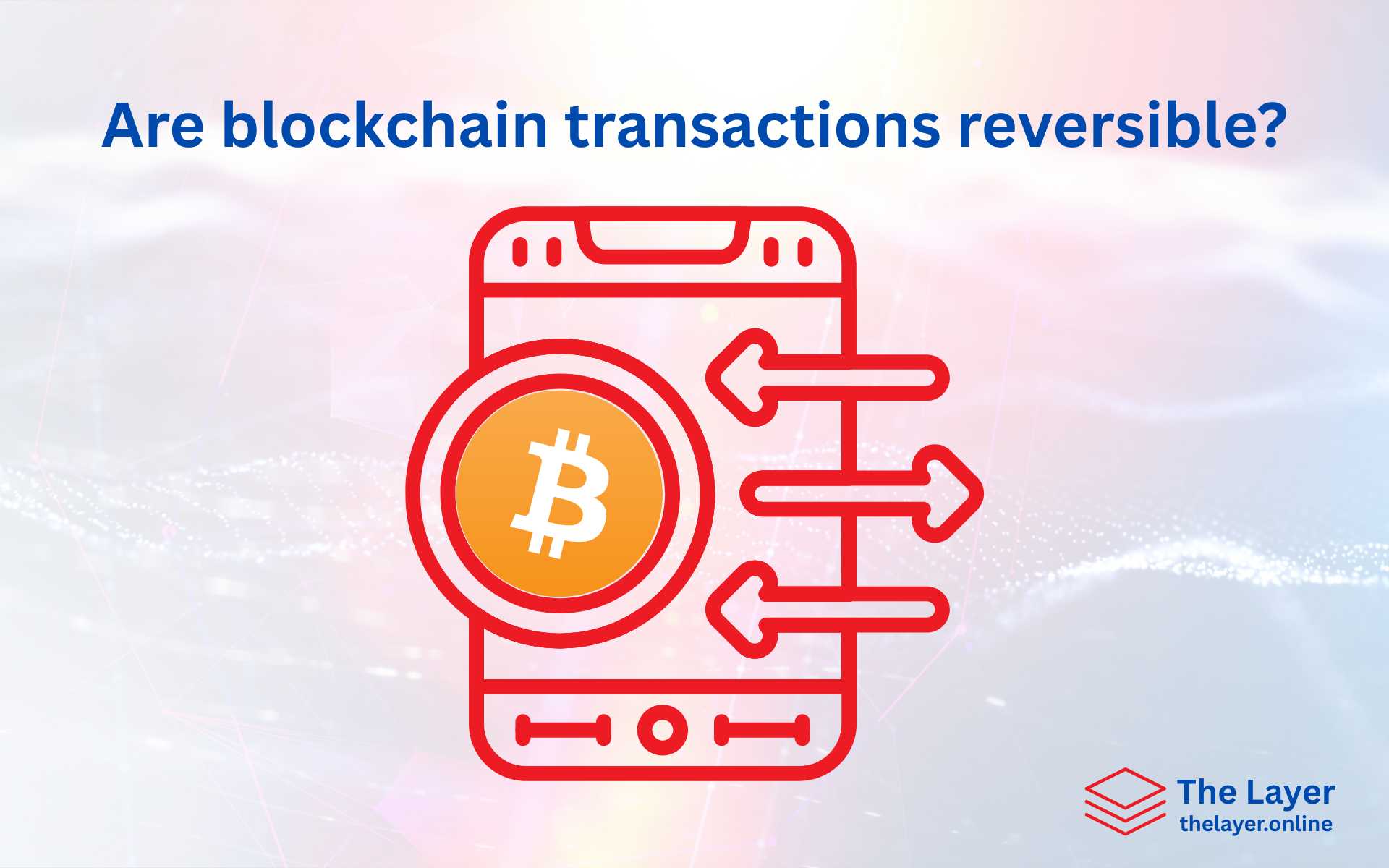

Yes, in rare conditions, such as a consensus or protocol hack, blockchain transactions can be reversed. These reversals must obtain a majority consensus in the community. Otherwise, there is a risk that disgruntled people will create a hard fork, as happened with Ethereum after the 2016 DAO Hack.
Put simply, blockchain transactions can only be reversed under very rare circumstances and not due to individual losses.
Table of Contents
Are blockchain transactions technically reversible?
Yes, blockchain transactions are technically reversible via a soft fork. However, they are not made that way because blockchains operate in a trustless environment, where finality builds trust.
If a transaction is made reversible, scammers might use it to first deposit funds, get their work done, and then reverse the transaction, getting double benefit, i.e., getting what they want without spending money, which is essentially double spending, one of the oldest problems in digital currencies before Bitcoin.
How does the reversal work?
When a blockchain wants to reverse a transaction, it must cancel the transaction and all subsequent transactions via a soft fork or a hard fork. A soft fork technically reverses the transactions in question and all subsequent ones.
Subsequent transactions need to be reversed because blockchains are linear. Since all subsequent blocks have the hash of the previous one in their headers, we cannot remove one from the middle, because after that, the last block of the removed block and the next block would be incompatible.
Another route is to invalidate the block containing the malicious transaction, as happened in Bitcoin in 2010.
This has happened in many cases listed below.
Real Life Examples
- On August 15, 2010, a hacker created 185 billion Bitcoins after exploiting a bug in block 76,638. The block was reversed without a soft fork within a few hours with a new Bitcoin version of 0.3.1.
- The 2016 (June 17 to 20) Ethereum DAO hack led to a transaction reversal, in which the transaction containing the stolen funds was erased.
- Following a hostile takeover of the Steem blockchain by Justin Sun on May 20, 2020, the community voted to confiscate funds from 64 accounts via a transaction reversal and split to safeguard decentralization.
What if a part of the community disagrees with the reversal?
If a part of the community disagrees with the reversal, they can split the chain into a newer branch via a hard fork. The new fork retains all past transactions up to that point, but after that, it is incompatible with the older chain.
After the DAO hack in Ethereum, such a hard fork created the Ethereum Classic chain.
Frequently Asked Questions
Can exchanges reverse crypto transactions?
Yes, but only if the transaction happens in its internal network. If you send or receive funds from an external blockchain or exchange, they are irreversible.
What happens if crypto is sent to the wrong address?
If a crypto is sent to the wrong address it is lost forever, even if the address does not exist.
Do failed or stuck transactions get reversed?
No, they do not complete, which means your funds are never deducted in the first place. However, if a transaction is temporarily stuck due to a bottleneck, such as network congestion, it will complete once the bottleneck is removed.
Disclaimer: The current article by The Layer is for informational purposes only and does not constitute trading or investing advice. Please refer to a financial consultant before trading or investing.